

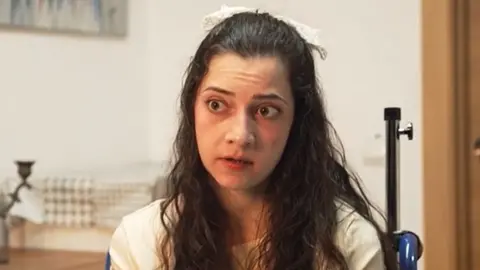
 Y Ahora Sonsoles (Atresmedia Television)
Note: This story contains references to sexual assault and self-harm.
The passing by medically assisted death of a 25-year-old Spanish female following a protracted legal battle with her father has triggered discussion about the responsibility of the state in caring for her and why it was so delayed to carry out her desire to die.
Noelia Castillo, who had been rendered paraplegic due to injuries sustained when she tried to take her own life in 2022, passed away on Thursday evening at a Barcelona hospital.
The Catalan regional government had granted her the authorization to euthanasia in 2024.
However, the procedure was halted at the last moment following court challenges filed by her father, supported by the advocacy organization a Christian legal group.
The situation has received enormous attention in Spain, with the legal group trying to block her passing until the last moment.
After an 18-month court fight, the Strasbourg court ruled this week in Noelia Castillo's favour and her passing was eventually confirmed in the late hours on Thursday.
A Troubled History
Castillo had passed much of her early years in state institutions and had described the impact on her mental health of her father's problems with drinking and of being sexually assaulted by an ex-boyfriend and also by several individuals in a nightclub.
In a TV interview this week, she said no one in her immediate family had supported her choice to die by euthanasia, and her parent "did not respect my decision and never would".
"I want to pass in peace now and stop my pain," she said to a television channel the day before she passed away.
Her parent had disagreed with her choice but joined her at the hospital.
A ex-friend of Castillo, Carla Rodríguez, tried to enter the clinic to convince her to change her mind, but informed media that police had prevented her from going in.
A UK musician living in the country made an appeal to her via social media to think again and proposed to cover her healthcare expenses until she felt "in a position to take this decision from a somewhat more tranquil place".
Systemic Shortcomings Debated
The legal group argued that her situation had highlighted deficiencies in her care.
"For a girl who obviously has had a extremely difficult existence, which we all regret, the sole option that could be provided to her by the public health system is death," said a spokesperson for the group.
The main conservative party, which voted against a 2021 euthanasia law, had a similar reaction.
"The institutions that should have safeguarded Noelia failed her," posted the group's leader on social media. He continued: "I decline to believe that the state did not have the means to give her proper support."
In a declaration, the Catholic Church, said that Castillo case "reflects an build-up of individual pain and systemic letdowns".
Legal Obstacles and Support
However, other commentators have criticized the fact that her wishes were thwarted by court appeals put in her path by her parent and the legal group.
"The wish to put an end to her suffering by exercising the right to euthanasia was… undermined by a legal crusade that added nearly two years of suffering to her life," commented a progressive publication in an opinion piece.
A member of Congress for a leftist political coalition said that "19 doctors have endorsed her decision and we should be accepting of it", while adding that it was a "profoundly complicated" matter.
Spain's Assisted Dying Law
The nation is one of a handful of EU nations, including the Netherlands, Belgium and Luxembourg, that have enacted regulations allowing medically assisted death to be performed by physicians.
Under Spain's 2021 law, any Spanish person over eighteen requesting assisted dying must be suffering from an incurable disease or "severe, long-term and incapacitating condition" and their decision must be made without external pressure.
The decision needs to have been expressed twice in written form and has to be validated by a doctor who then seeks a second opinion with another doctor.
The application then passes to a Guarantee and Evaluation Commission, which has the task of determining if the requirements have been met.
According to official figures, 426 applications for assisted dying were granted in 2024, the most recent period for which data is accessible. This was the initial instance that a request was taken to court for a court to decide.


